How to choose a tree surgeon: what to check before you hire
Posted on: August 24th 2026 • Posted in: Guides
There are three key things to check when choosing a tree surgeon before any work is agreed: proof of qualifications, current public liability insurance, and membership of a recognised body such as the Arboricultural Association. Tree work is unregulated in the UK, so unfortunately anyone can advertise as a tree surgeon regardless of training, which makes these checks the difference between a safe, well-executed job and a costly mistake. This article sets out exactly what to check and the key questions to ask.
| Key takeaways |
|---|
| Tree surgery is not a regulated profession in the UK, so qualifications and insurance must be checked directly rather than assumed. |
| Ask to see proof of public liability insurance and City and Guilds (formerly NPTC) certificates before work starts. |
| Arboricultural Association Approved Contractor status means a company has been independently audited against national standards. |
| Get a written quotation that specifies the exact work and be cautious of anyone who cold-calls or pressures you to agree on the spot. |
| Reputable tree surgeons will discuss any Tree Preservation Orders or conservation area restrictions affecting your tree before starting work. |
| A lower quote is not always better value. Poor pruning or felling can permanently damage a tree or cause expensive property damage. |
What qualifications should a tree surgeon have?
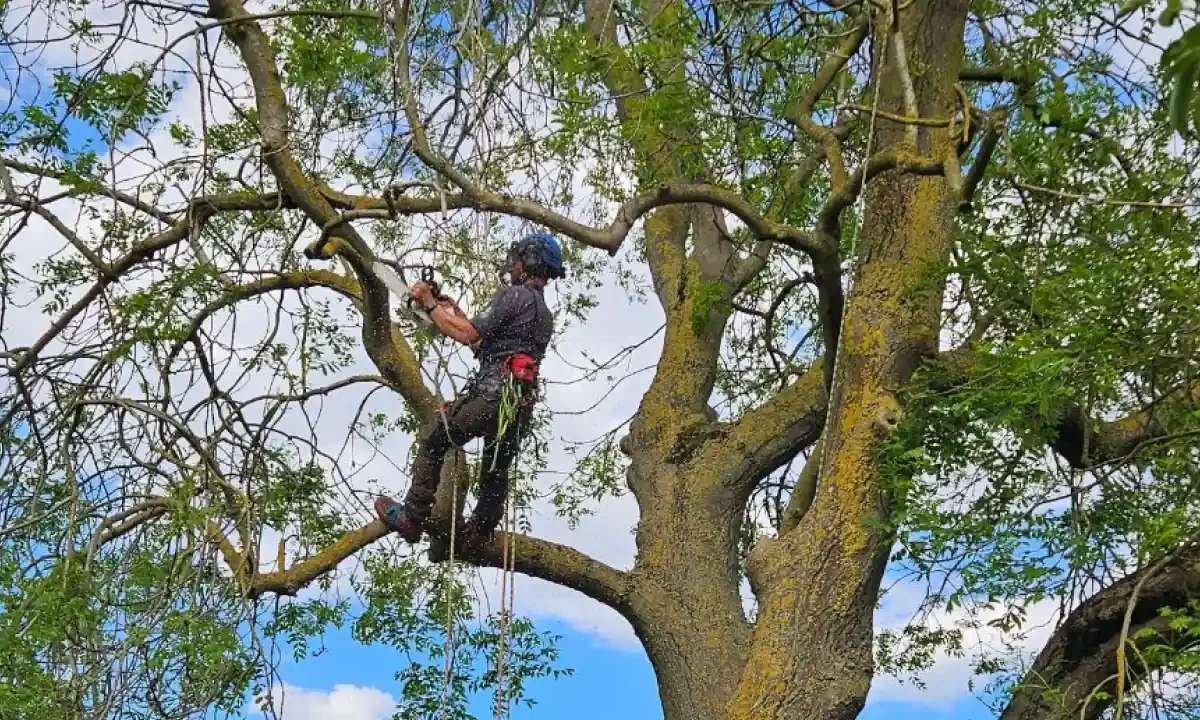
A tree surgeon should hold City and Guilds qualifications (the successor to NPTC certificates) covering chainsaw use, aerial rescue and tree climbing, as these confirm they have been trained and assessed in the safe use of the equipment involved in tree work. Anyone working at height with a chainsaw should be able to show a certificate specific to that task, since different certificates cover ground-based chainsaw work, use of a chainsaw from a rope and harness, and aerial rescue procedures.
It is also worth asking whether the company employs staff with formal arboricultural qualifications, such as a Level 2 or Level 3 qualification in arboriculture, particularly if the work involves assessing tree health or advising on a Tree Preservation Order. This level of technical knowledge goes beyond the practical skill of operating a chainsaw and covers how decisions about pruning or felling affect a tree’s long-term health.
Are tree surgeons insured?
Not automatically, so this must be confirmed directly with the company before any work begins. Tree work carries a genuine risk of injury and property damage, from falling branches to damage caused during felling, and a reputable tree surgeon will hold public liability insurance and be able to provide a current certificate on request. It is also sensible to ask about employers’ liability insurance if the company has staff working on site, as this protects their employees while working on your property.
What does Arboricultural Association Approved Contractor mean?
Arboricultural Association Approved Contractor (ArbAC) status means a company has been independently audited and assessed against the Association’s national standards, covering technical competence, health and safety compliance, and business practice. The Arboricultural Association is the UK’s principal professional body for tree care, and its Approved Contractor scheme has been setting industry standards for tree surgery work for more than 40 years. Because arboriculture is not regulated by government, this kind of independent assessment is one of the clearest signals that a company operates to a recognised standard rather than self-certifying its own competence.
Approved Contractors are reassessed annually to confirm they continue to meet the required standard, covering areas such as staff training records, equipment condition, and how complaints are handled. Membership of the Association of Professional Landscapers (APL) serves a similar purpose for landscaping work, confirming that a company has met the trade body’s standards for that side of the business.
What questions should I ask a tree surgeon before hiring them?
Ask to see proof of insurance, qualifications and any relevant accreditation before agreeing to any work, along with a written quotation that describes exactly what will be done. Useful questions include:
- Can I see your public liability insurance certificate?
- Which City and Guilds or NPTC certificates do your climbers hold?
- Are you an Arboricultural Association Approved Contractor, or a member of a recognised trade body?
- Will the work require permission, for example because of a Tree Preservation Order or the property being in a conservation area?
- What will happen to the arisings (branches, timber and chippings) after the work is done?
- Can you provide a written quotation and, if relevant, references from previous local work?
A tree surgeon confident in their standards will answer these questions readily and without hesitation.
How do I choose between quotes from different tree surgeons?
Compare quotes on what is actually included, not just the total price, since the cheapest quote often means less time on site, no waste removal, or corners cut on safety equipment and site protection. A thorough quotation should specify the exact trees involved, the work to be carried out (for example crown reduction, crown thinning, pollarding or dead wooding), whether stump grinding and waste removal are included, and an estimated timescale.
It is also worth being cautious of anyone who cold-calls offering to carry out work immediately, particularly after a storm, as this is a common approach used by unqualified operators. A genuine tree surgeon will be willing to visit, assess the tree, and provide a written quotation rather than pressuring you to agree to work on the spot.
Do I need permission before having tree work done?
This depends on whether the tree is covered by a Tree Preservation Order (TPO) or is within a conservation area, so it is worth checking with your local planning authority before work starts. An established tree surgeon should ask about this as a matter of course and will be able to advise on whether an application is needed before any cutting, pruning or felling takes place. Carrying out unauthorised work on a protected tree can result in a substantial fine, so this check should never be skipped.
Frequently Asked Questions
Do I need to check a tree surgeon’s insurance myself?
Yes. Tree work is unregulated, so there is no automatic requirement for a company to hold insurance and no central register that confirms it. Ask to see a current public liability insurance certificate directly, and if a company is reluctant to provide one, treat this as a warning sign.
Is Arboricultural Association membership the same as being an Approved Contractor?
No. General membership of the Arboricultural Association is open more widely, whereas Approved Contractor (ArbAC) status requires a company to pass an independent audit of its technical competence, health and safety practice and business management. Approved Contractor status is the more rigorous of the two.
How much does it cost to hire a qualified tree surgeon?
Costs vary considerably depending on the size and species of tree, access to the site, and the type of work required, so a written quotation following a site visit is the most reliable way to establish a price.
Can I get in trouble for hiring an unqualified tree surgeon?
The legal responsibility for tree work carried out without required permissions, such as work affecting a tree with a Tree Preservation Order, generally sits with the property owner rather than the contractor. This makes it particularly important to confirm any necessary permissions before work begins, regardless of who is doing the work.
What is the difference between a tree surgeon and an arborist?
In practice the terms are used interchangeably in the UK. Arborist tends to be used for those with a broader technical and horticultural knowledge of tree biology, while tree surgeon is the more familiar term for someone carrying out practical work such as pruning, felling and stump removal.
In summary
Choosing a tree surgeon comes down to verifying qualifications, insurance and accreditation before work starts, rather than relying on advertising or price alone. Checking Arboricultural Association Approved Contractor status, City and Guilds certificates and public liability insurance gives a clear, verifiable picture of a company’s standards.
Details of our qualifications, insurance cover and Arboricultural Association Approved Contractor status can be found on our accreditations page.
Sources cited
-
- Arboricultural Association, ARB Approved Contractor scheme: trees.org.uk/Accreditation/Become-an-ARB-Approved-Contractor
- Malvern Hills District Council, Choosing a Tree Surgeon (local authority guidance): malvernhills.gov.uk
- Health and Safety Executive – Tree work: hse.gov.uk/treework